

Types of parquet adhesives
 |
| Source: direct floor |
 |
| Source: direct floor |
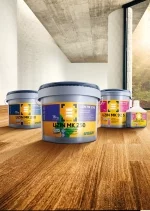
- An example of such an adhesive is UZIN MK 80 S, which will work well when installing parquet that is not sensitive to swelling. Its advantages are very good stability and high shear strength as well as the absence of solvents. It can be used to glue 8-mm mosaic, traditional parquet (22 mm) - with maximum dimensions of 22 x 70 x 350 and two-layer parquet with maximum dimensions of 70 x 500 mm. However, this type of glue is not recommended for less stable types of wood, explains Janusz Dziewanowski, sales manager at UZIN.
Polyurethane adhesives - without solvents and water
This type of glue comes in two versions: one-component and two-component. Polyurethane adhesives have a wide range of applications - they can be used to glue both traditional parquet and layered boards. It is a flexible adhesive, so it works well on solid wood floors.
Polyurethane adhesives have many advantages: they are durable, non-shrinking, set quickly and can be used for underfloor heating. For the two-component version, it is necessary to mix the adhesive with the hardener. It also determines the time when such an adhesive can be used. However, two-component polyurethane adhesives are the most popular type of adhesive on the market.
An example of a two-component polyurethane adhesive offered by UZIN is MK 92 S, which is a universal solution for installing all types of wooden floors. In turn, an example of a one-component polyurethane adhesive is UZIN MK 95. It is recommended for gluing wooden elements that are not varnished on both sides. This is due to the fact that polyurethane adhesives do not stick to painted surfaces.
 |
| Source: direct floor |
 |
- One-component adhesives are a good solution when it is necessary to "switch" a larger work of wood in relation to the substrate, e.g. with board elements up to 10 cm wide, but with a thickness of 22 mm - explains Janusz Dziewanowski. – With thinner elements, with a lot of work on the floor, its edge deformation may occur, because one-component polyurethane adhesives are really very flexible.
Polyurethane adhesives modified with silane - the optimal solution
Silane-modified polyurethane adhesives are the optimal solution because they combine the advantages of two-component polyurethane adhesives with the convenience of a one-component agent.
- A good example of such an adhesive is MK 200 by UZIN - it will work well with any type of wooden floor (of course, except for varnished from the bottom). Its advantage is that it is one-component, which greatly facilitates the work of parquet installers, the adhesive also has much lower consumption and is more environmentally friendly. An additional advantage is the relatively fast setting time for this type of product - the glue begins to set after about 40 minutes, but correction works can be carried out for about three hours - adds Janusz Dziewanowski from UZIN.
Silane-modified polyurethane adhesives have another important advantage - they leave no traces on the surface of a varnished or "ready-oiled" element of a layered floor, and any dirt can be easily cleaned after installation. In the case of two-component adhesives on finished floors, regular cleaning must be strictly observed - after drying, they are practically not removed.
There are also solutions available on the market dedicated to particular types of flooring, e.g. layered parquet. The choice of the best solution should be preceded by the recommendation of an experienced professional who, based on the assessment of the substrate and the type of wooden floor, will select the most optimal adhesive.