
How have stairs changed in 30 years?
Single-speed, two-speed, spiral and fan-type. With a ZETA step-substep design or a cheek piece. With or without landing. The selection of wooden stairs on the Polish market is currently huge. The richly decorated ones, as well as the simple ones without any decorations, are very popular. However, this was not always the case. How have stairs and their fashion changed over the last 30 years?
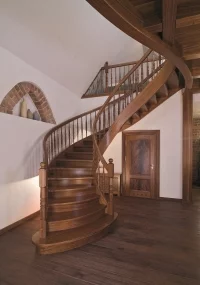 |
| Classic wooden stairs, photo: Marchewka Stairs - Floors - Interiors |
Stairs have always been one of the most important elements of interiors. Initially, they were made of stone or steel. Only later did wooden ones appear. The oldest stairs made of this material are about 7,000 years old and are located in Hallstatt, Austria. In the Polish context, it is difficult to talk about such long traditions. However, there are a few breakthrough moments worth mentioning.
Freaky 90s
Even in the late 1980s and early 1990s, classic straight stairs remained very popular. Irreplaceable in homes. Both in one line without treatments and enriched with landings or platforms. Everything depended - and still depends - on individual needs. However, the second half of the 1990s brought a breath of freshness. At that time, curved stairs appeared on the market.
– Immediately after introducing these stairs to the Polish market, their design was highly appreciated by customers. What fascinated them most was how wood could be bent like that. Moreover, these stairs are simply beautiful - says Stanisław Marchewka, the precursor of curved stairs, president of the management board of Marchewka Schody - Podłogi - Wnętrza, which celebrates its 30th anniversary this year.
Curved stairs are not only an important architectural detail. They have also gained great popularity due to their functionality. They work very well in rooms with a small staircase area or in two-story apartments.
2004 - the year of the "staircase revolution"
At the beginning of the second millennium, ZETA step-step stairs, also known as carpet stairs, appeared on the Polish market. This self-supporting structure without stringer beams, consisting of steps and risers, was appreciated by individual clients and architects from the very beginning. This simple type of stairs, despite its solid construction, is surprisingly light. It works very well in modern interiors, offering many arrangement possibilities. ZETA stairs can be free-standing, placed on concrete or attached to a wall.
– When we introduced these stairs to the market, we knew that our customers would immediately love them. They enjoy unflagging popularity to this day. Their appearance is a perfect reflection of current fashion, says Stanisław Marchewka. – Although richly decorated, even Renaissance stairs are still popular, stairs with simple forms that highlight the beauty of the raw material used are becoming more and more popular – adds Stanisław Marchewka.
It can be noticed that in staircase fashion we are seeing a return to the classics. An original design, even the most carefully crafted, may simply get boring. However, this does not mean a return to pre-Renaissance practices, when functionality was the only priority. Simple forms can also be beautiful if we use the highest quality wood and take care of its proper processing.
How do experts see the future of stairs in Poland? Can the market still surprise us?
– Having been on this market since 1987, I know that this topic is demanding. But I also know that another breakthrough like curved or Zeta stairs is possible. We are still working on improving the structures we know and we make sure to select the best possible wood to provide our customers with the best possible product. I believe that more than one of our products will surprise the market and be appreciated by customers, says Stanisław Marchewka.