Acoustics in interiors - why are proper acoustic insulation so important?
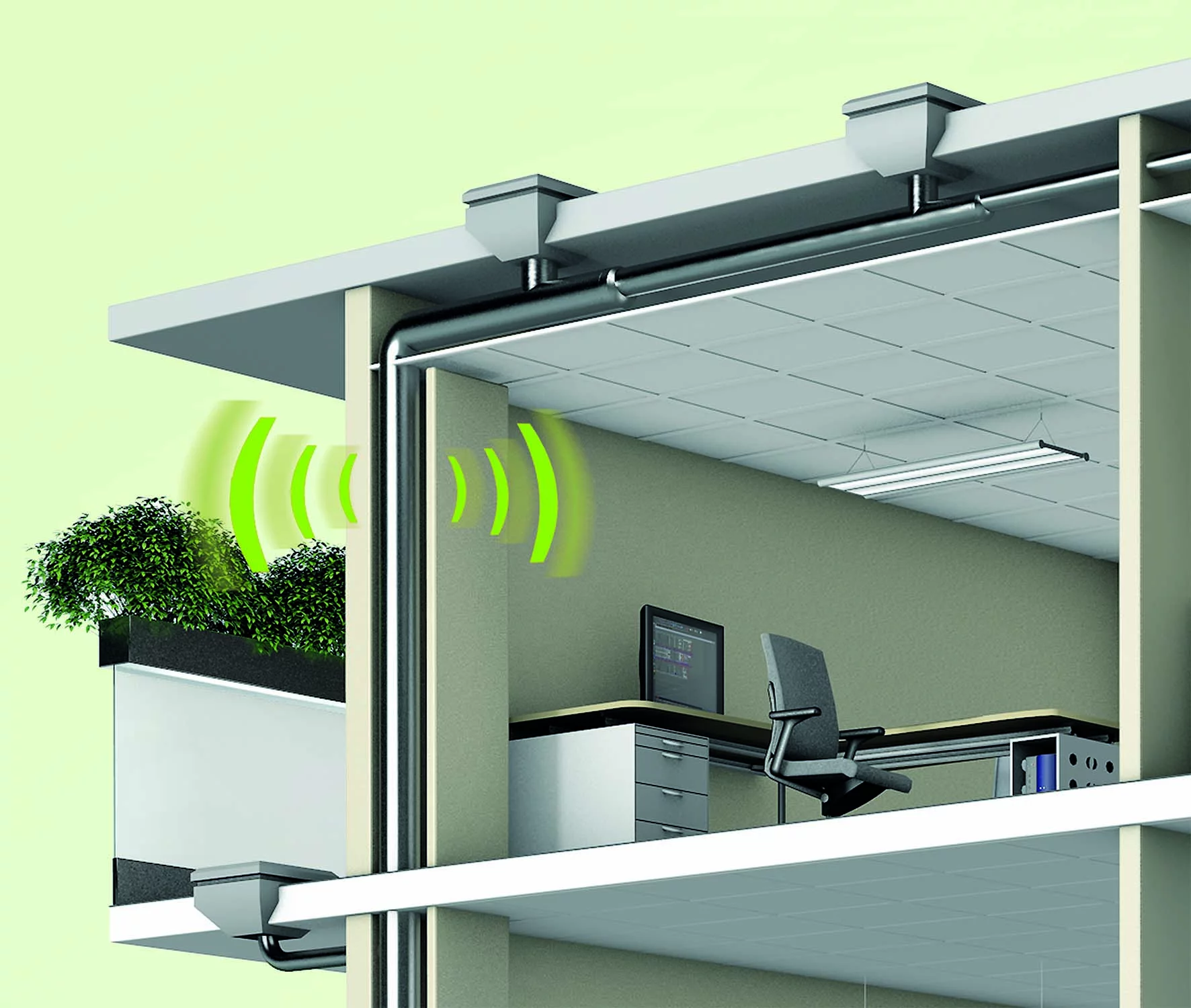
A house, apartment or office should be an oasis of peace and quiet, which is why the acoustics of buildings is such an important element, which is significantly influenced, among others, by the appropriate acoustic insulation of the partitions surrounding the interior. This applies in particular to walls and ceilings separating residential premises or noisy rooms, such as elevator shafts, ventilation rooms and technical areas. Maria Witkowska, technical director for market services at Armacell, suggests what is worth paying attention to when soundproofing a facility.
Sound transmission in the building
The comfort of using the rooms depends to a large extent on the appropriate sound insulation of the partitions surrounding them. Noise that is generated in one room is transmitted through most of the walls as a result of vibrations of the partition as a whole (direct transmission) or of a structural element of the building (lateral transmission). During the transition from one room to another, the vibrations of the partitions generate new airborne sound waves of reduced intensity. Losses in sound intensity determine how effective the sound insulation of elements and partitions in a room is. The requirements for acoustic insulation of partitions for various types of buildings are described in detail in Polish standards (PN-B-02151-3) and set the appropriate standards not only for public utility construction, but also for residential houses. The currently required acoustic insulation index R for partitions measured at the construction site is 45-50 dB, which in practice means that the Ra index tested in the laboratory should range from 48-53 dB.
Friendly partition acoustics - what is it?
The Ministry of Infrastructure has developed general guidelines for protection against noise in rooms, including, among others, with minimal sound insulation of walls and ceilings separating residential premises and noisy rooms. These values vary depending on the function of the room. The acoustic insulation of the partition will be affected by the material characteristics that stimulate the partition to vibrate, such as: density, elasticity, internal damping, porosity and dynamic stiffness. In turn, the reduction of the partition insulation is influenced by additional phenomena, such as the self-resonance of the partition and coincidence - explains Maria Witkowska, technical director for market services at Armacell. In order to avoid returning to old technologies and to improve the acoustic insulation of partitions available on the market, it is worth using appropriate insulation and acoustic barriers, such as those offered by Armacell.
Acoustic insulation as a way to protect against noise
Various types of partitions are used in investments. Depending on their construction, there are homogeneous, non-homogeneous, layered and multiple partitions composed of single partitions separated by air gaps.
In single-layer partitions (e.g. solid concrete walls), the transmission of sound penetration, according to the law of mass, depends on the massiveness of the structure. The more massive the wall, the less sound penetrates through the partition - emphasizes Maria Witkowska from Armacell. However, from the economic point of view, it is impossible to use only increasing the weight of the partition to improve its acoustic parameters. In practice, in modern facilities, multi-layer solutions are used, which should be as thin as possible to obtain the optimal usable area of the facility. In partitions (e.g. plasterboard walls) used in lightweight structures, sound transmission is carried out in accordance with the mass-spring law. A frame structure filled with sound-absorbing material is placed between the layers providing the weight of the partition. ArmaComfort Barrier thin acoustic barriers from Armacell can be used to achieve the desired acoustic performance of the mass-providing layer. Such an acoustic barrier, apart from the fact that it looks aesthetically pleasing, is self-adhesive and is perfect for soundproofing existing partition walls - emphasizes the Armacell expert. One of the methods to eliminate the negative impact of partition partition coincidence is also the use of layered partitions separated by a space filled with absorbent material, for example ArmaComfort PUR insulation
Armacell has the Insul calculation program for quick assessment of the sound insulation of various structures, using the database available in the program and using its own, manually entered materials. Thanks to this, you can approximately determine the sound insulation of sandwich walls and choose the best solution.
The use of acoustic barriers in buildings helps to achieve the required acoustic insulation values in both new and modernized investments. Thanks to the fact that the insulation is made of a thin material, and at the same time is extremely flexible, it will work well both in the insulation of walls, ventilation ducts and suspended ceilings. They show high resistance to fire, decay and most chemicals, and at the same time do not contain chemical compounds dangerous to users. It is worth remembering that errors or omissions in sound insulation can be very expensive and difficult for investors to remove. Therefore, when starting or modernizing an investment, it is necessary to carefully analyze how it should be designed and built so that the noise level does not exceed Polish standards and ensures peace and tranquility for the household members - sums up Maria Witkowska, technical director for market services at Armacell .